


Room Acoustic Simulation
Problem
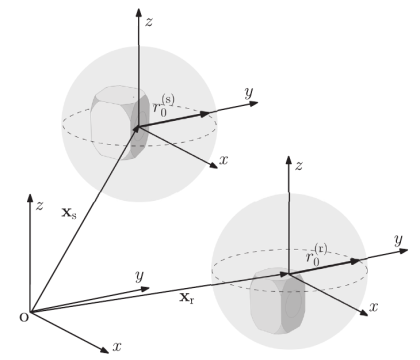
The image source method (ISM) is often used to simulate room acoustics due to its ease of use and computational efficiency. Its standard form, however, only handles point sources and omnidirectional receivers in a shoebox-shaped room. In practice, loudspeakers and microphones are mounted on audio devices of finite spatial extent, such as smart speakers, and the acoustic diffraction around the device enclosure changes the sound field. Rooms also rarely have shoebox shapes. Wave-based numerical methods such as the finite element method (FEM) capture all of this, but they are far too expensive for generating the large numbers of impulse responses needed to develop and evaluate audio algorithms.
Approach
The diffraction-enhanced image source method (DEISM) extends the ISM with spherical-harmonic directivity coefficients for the source and the receiver. The coefficients encode the local acoustic effects of a device, including diffraction, so that the image sources radiate sound wave and are received with the correct directional behaviour. The method was verified against FEM simulations for various loudspeaker and microphone configurations, and a simplified variant reduces the computational effort considerably. Building on this:
- Acoustic reciprocity in the spherical harmonic domain gives a formulation for directional sources and receivers that lets the roles of source and receiver be exchanged, which generalizes the formulation of transfer functions between devices.
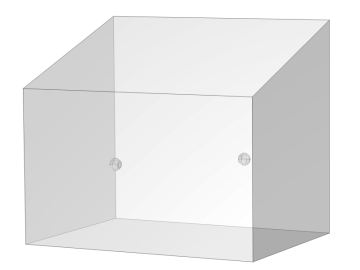
- Arbitrary room geometries (DEISM-ARG): mirroring spherical-harmonic directivities about walls with arbitrary normal vectors extends DEISM from shoebox rooms to general polyhedral rooms. Comparisons with FEM show good agreement between 20 Hz and 1 kHz for rooms with tilted ceilings, and the remaining mismatches point to acoustic effects that ISM-based methods still miss, e.g., wave diffraction.
- Atmospheric fluctuations: the ISM is extended to incorporate temperature-induced variability through a deterministic temperature drift and a stochastic local volatility, so that repeated RIR simulations reproduce the subtle variations observed between successive real-world measurements. The extension is implemented in the open-source DEISM simulator.
- Validation and accuracy: comparison of DEISM predictions with measured data in a shoebox-shaped room, and a study of the higher DEISM errors in tilted ceiling room. The errors of the ISM were analyzed in a simplied scenario using a point source near two adjoining impedance walls.
Public resources
- Code: DEISM on GitHub, a Python package including the arbitrary-geometry extension and examples.
- Documentation: deism.readthedocs.io.
- Publications directly related to DEISM, in chronological order (full list on the publications page):
- Derives a reciprocal relation between source and receiver directivity coefficients, including acoustic scattering effects. Acoustic reciprocity in the spherical harmonic domain: A formulation for directional sources and receivers, JASA Express Lett., 2022, doi:10.1121/10.0016542.
- Introduces DEISM: ISM with spherical harmonic directivity coefficients capturing acoustic diffraction effects of devices. Simulating room transfer functions between transducers mounted on audio devices using a modified image source method, J. Acoust. Soc. Am., 2024, doi:10.1121/10.0023935.
- Validates DEISM against data measured in a shoebox-shaped room. Towards validating the diffraction-enhanced image source method, Proc. Inter-Noise, 2024, doi:10.3397/IN_2024_3509.
- Extends DEISM to arbitrary room geometries (DEISM-ARG) and reveals missing acoustic effects. Simulating sound fields in rooms with arbitrary geometries using the diffraction-enhanced image source method, Proc. IWAENC, 2024, doi:10.1109/IWAENC61483.2024.10693991.
- Analyzes ISM errors for a point source near two adjoining impedance walls. On the accuracy of the image source method in the presence of two adjacent impedance walls, Proc. Forum Acusticum / Euronoise, 2025, doi:10.61782/fa.2025.0644.
- Incorporates temperature-induced variability via global deterministic drift and stochastic local volatility. Integrating atmospheric fluctuations into the image source method, JASA Express Lett., 2026, doi:10.1121/10.0044473.