


Room Impulse Response Completion
Problem
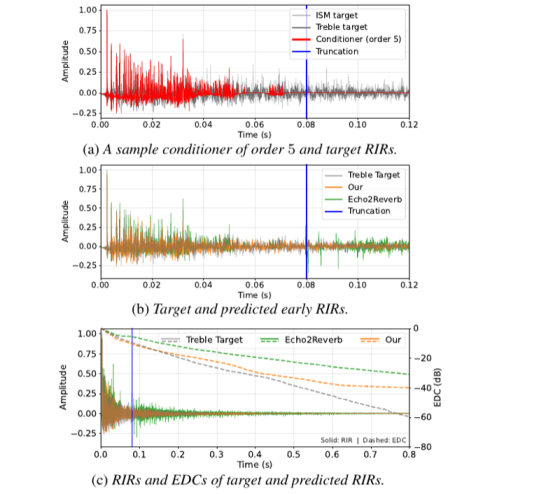
Room impulse responses (RIRs) are fundamental to audio data augmentation, acoustic signal processing, and immersive audio rendering. Geometric simulators such as the image source method (ISM) can generate the direct path and early reflections efficiently, but the result lacks the realism of measured RIRs because acoustic wave effects are missing and the late reverberation is modelled poorly. RIR completion addresses this by predicting the full RIR from its first 50 to 80 ms, the so-called RIR head. Existing completion methods, however, require a head that has been truncated from a complete simulated or measured RIR. A low-order ISM simulation, which is what a simulator usually delivers, is incomplete within that window, and feeding it to those methods produces temporal discontinuities in the completed RIR.
Approach
We propose a diffusion model that is conditioned only on the ISM-simulated direct path and early reflections and generates the complete full-band RIR:
- Signal prediction (x-prediction) instead of noise prediction: the network directly predicts the target RIR at each diffusion step, which conditions directly on the early part and allows an energy decay curve (EDC) loss to be evaluated on the predicted RIR.
- No fixed duration constraint on the input early reflections: the conditioner is a low-order ISM simulation of any maximum reflection order, down to first-order reflections, and no truncated RIR head from a complete RIR is required.
- Classifier-free guidance (CFG) trained on a hybrid dataset of ISM simulations and a small proportion of physically realistic RIRs simulated with the Treble SDK steers generation toward the realistic target distribution, even when the training data are dominated by ISM-simulated RIRs.
- EDC loss combined with the MSE loss improves the preservation of consistent energy decay characteristics.
On both an ISM test set and a more realistic Treble test set, the method matches the state-of-the-art baseline when trained on ISM data alone and outperforms it in early-RIR completion and EDC reconstruction when trained with classifier-free guidance.
Public resources
- Preprint: arXiv:2603.12442, to appear at Interspeech 2026.
- Citation on the publications page.