


Pulsetable Synthesis of Wind Instrument Tones
Welcome to the accompanying website for to the following demo paper:
- Christian Dittmar, Simon Schwär, Manuel Peters, Stefan Balke, and Meinard Müller
Pulsetable Synthesis of Wind Instrument Tones
In Demo Papers of the International Conference on Digital Audio Effects (DAFx), 2026. PDF Details@inproceedings{DittmarSPBM26_PulsetableSynthesis_DAFx, author = {Christian Dittmar and Simon Schw{\"a}r and Manuel Peters and Stefan Balke and Meinard M{\"u}ller}, title = {Pulsetable Synthesis of Wind Instrument Tones}, booktitle = {Demo Papers of the International Conference on Digital Audio Effects ({DAFx})}, year = {2026}, address = {Boston, MA, USA}, url-pdf = {https://www.dafx.de/paper-archive/2026/papers/DAFx26_demo_60.pdf}, url-details = {https://www.audiolabs-erlangen.de/resources/MIR/2026_DittmarSBM_PulsetableSynthesis_DAFx}, }
Abstract
We revisit pulsetable synthesis, an efficient technique for generating plausible and expressive wind instrument tones. Based on the principles of pulse forming theory, this method models sound production as the periodic repetition of shaped pulses characterizing the target instruments' spectral envelope. In this approach, single-cycle waveforms, referred to as pulses, are stored in pulsetables indexed by their corresponding fundamental frequency. During synthesis, the pulses are read from these tables to form a periodic waveform, which is further shaped by time-varying low-pass filtering, amplification, and reverberation. These processes are guided by control signal contours that describe how fundamental frequency, brightness, and loudness evolve over time. Through case studies with real-world wind instrument recordings, we show how the interplay between these control signals gives rise to articulations such as attack transients, vibrato, and growl. Finally, we discuss the potential of this framework for integration into Differentiable Digital Signal Processing (DDSP) models, where neural networks could learn synthesis parameters directly from training data.
Pulsetable Synthesis System Overview

Pulse Shapes
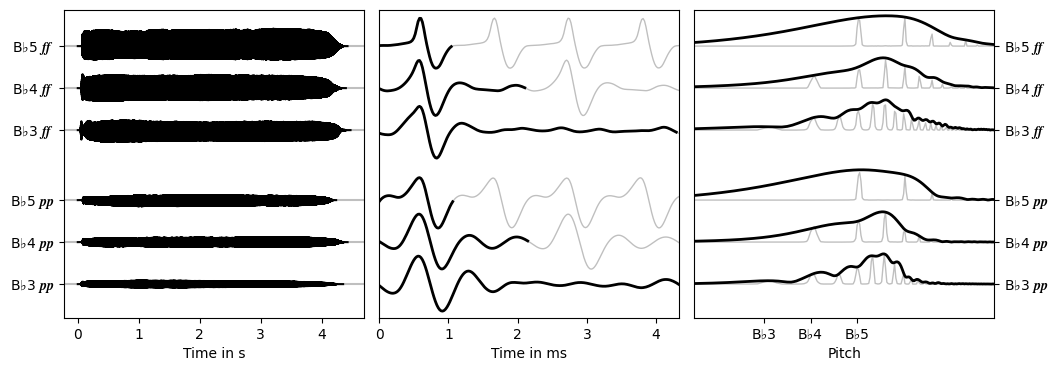
Here, we show three trumpet tones from the MIS Database, recorded in anechoic conditions. For visualization purposes, we selected pitches that are spaced three octaves apart, the lowest being B♭3. In the upper half of the plot, the tones are played at highest intensity (fortissimo, ff), in the lower half they are played at lowest intensity (pianissimo, pp). For each tone, we present the original recording, a pulsetable synthesized version with static control signal contours and a pulsetable synthesized version using the control signal contours F0, Fc, and G extracted from the original recording, acting as micro-modulations for pitch (F0), brightness (Fc) and loudness (G).
Feature Extraction, Synthesis and Transposition of an Oboe Recording
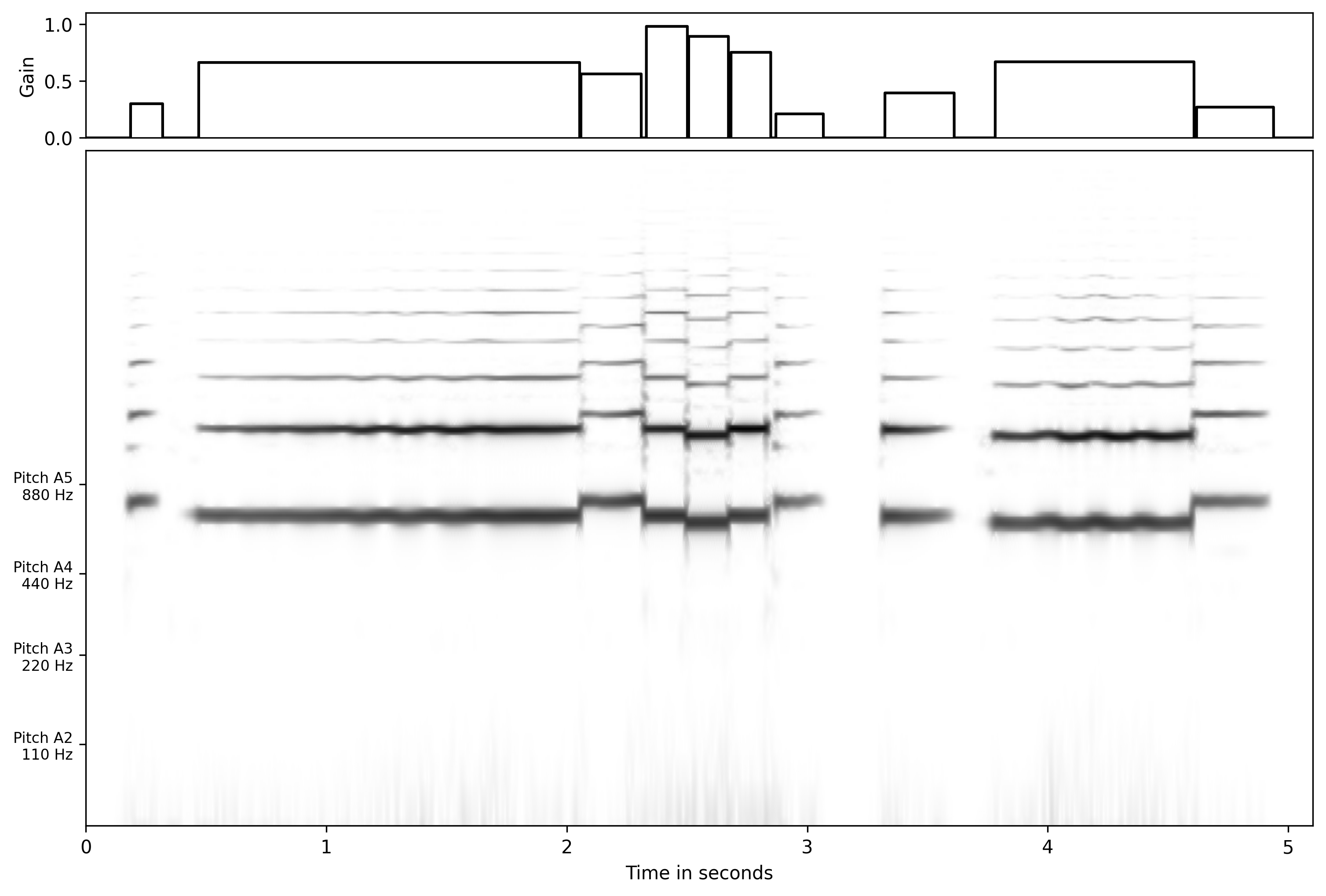
Here, we use an oboe recording from the PHENICX Dataset to illustrate our procedure for extracting control signal contours of F0, Fc, and G. The melody is an excerpt of the first oboe in the 1. movement of Ludwig van Beethoven's Symphony No. 7. More pecisely, it is abridged from bars 24 to 26, corresponding to the time interval 1:32 to 1:37 in the PHENICX recording. For feature extraction, the original melody annotations provided in the PHENICX dataset are used to separate the fundamental and suppress all other time-frequency components by means of STFT-based spectral masking. This indicated by the red bounding boxes around the fundamental. We yield the analytic signal by inverse STFT and subsequently track the instantaneous frequency (phase difference) and instantaneous envelope (complex modulus / magnitude) of this complex-valued sinusoid. Further postprocessing involves smoothing with a 200Hz, zero-phase low-pass filter (Butterworth). This procedure yields the control signal contours F0 and G. Fc is then derived by shifting and scaling G with heuristically optimized parameters. All control signal contours corresponding to G < 0.05 are considered invalid as they are likely unpitched. For resynthesis, an oboe pulsetable based on anechoic single note recordings in the MIS Database is used. The last two rows show that transposition to a lower octave yields quite natural results with our method, while the pitch-shifting with Melodyne introduces some artifacts.
Attack Transients Listening Examples
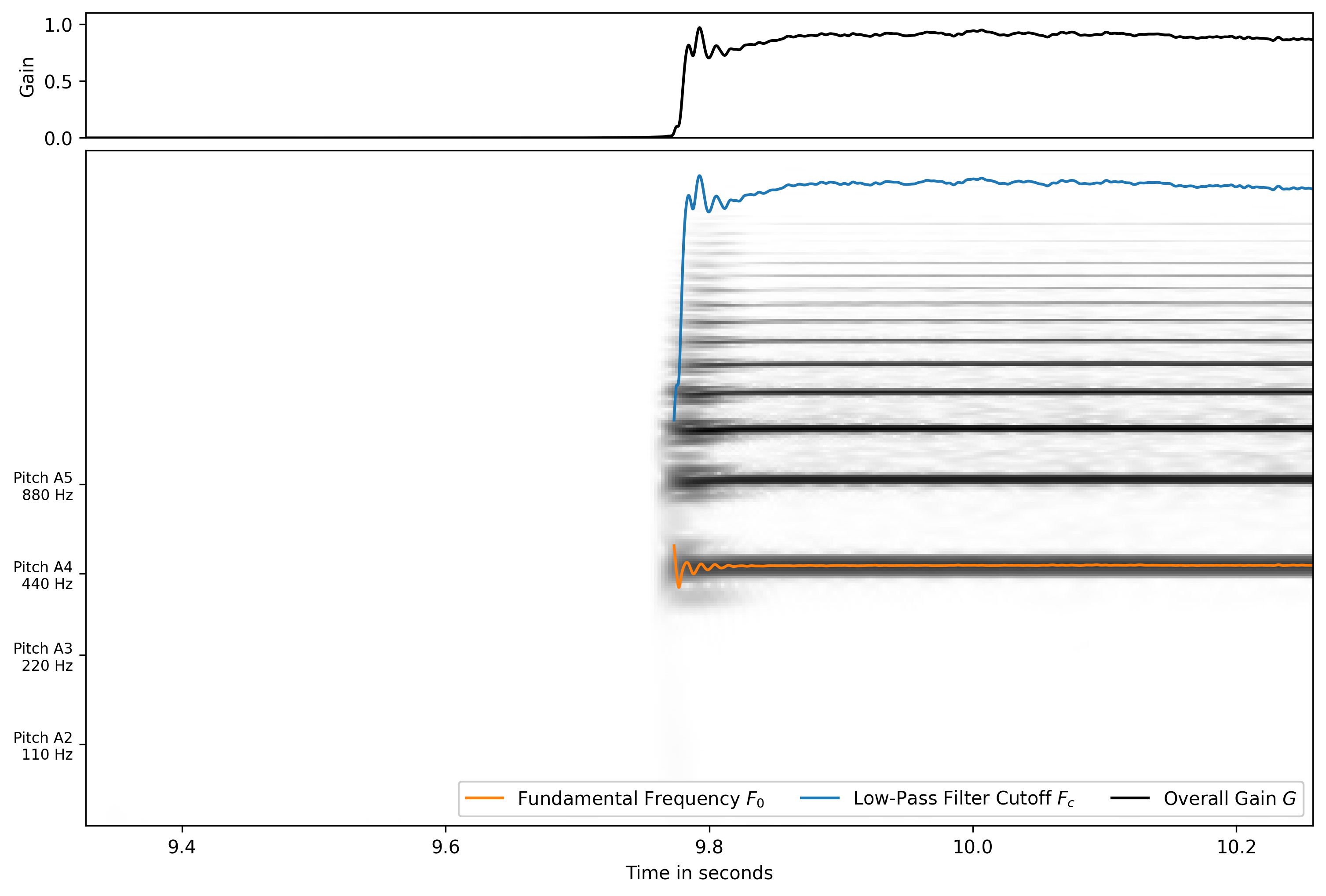
In this example, we zoom in on the attack transient of a B♭4 trumpet tone played with fortissimo intensity. The audio ist taken from the MIS Database and has been recorded in anechoic conditions. We can observe a typical phenomenon related to note onsets on brass instruments: rapid modulation of all three control signal contours produces inharmonic side-bands similar to those in amplitude or frequency modulation. Since they only occur for a very short duration, they are perceived as attack transients. Deliberately removing those micro-modulations from the pulsetable synthesis leads to an overly soft, unnatural attack.
Vibrato Listening Examples
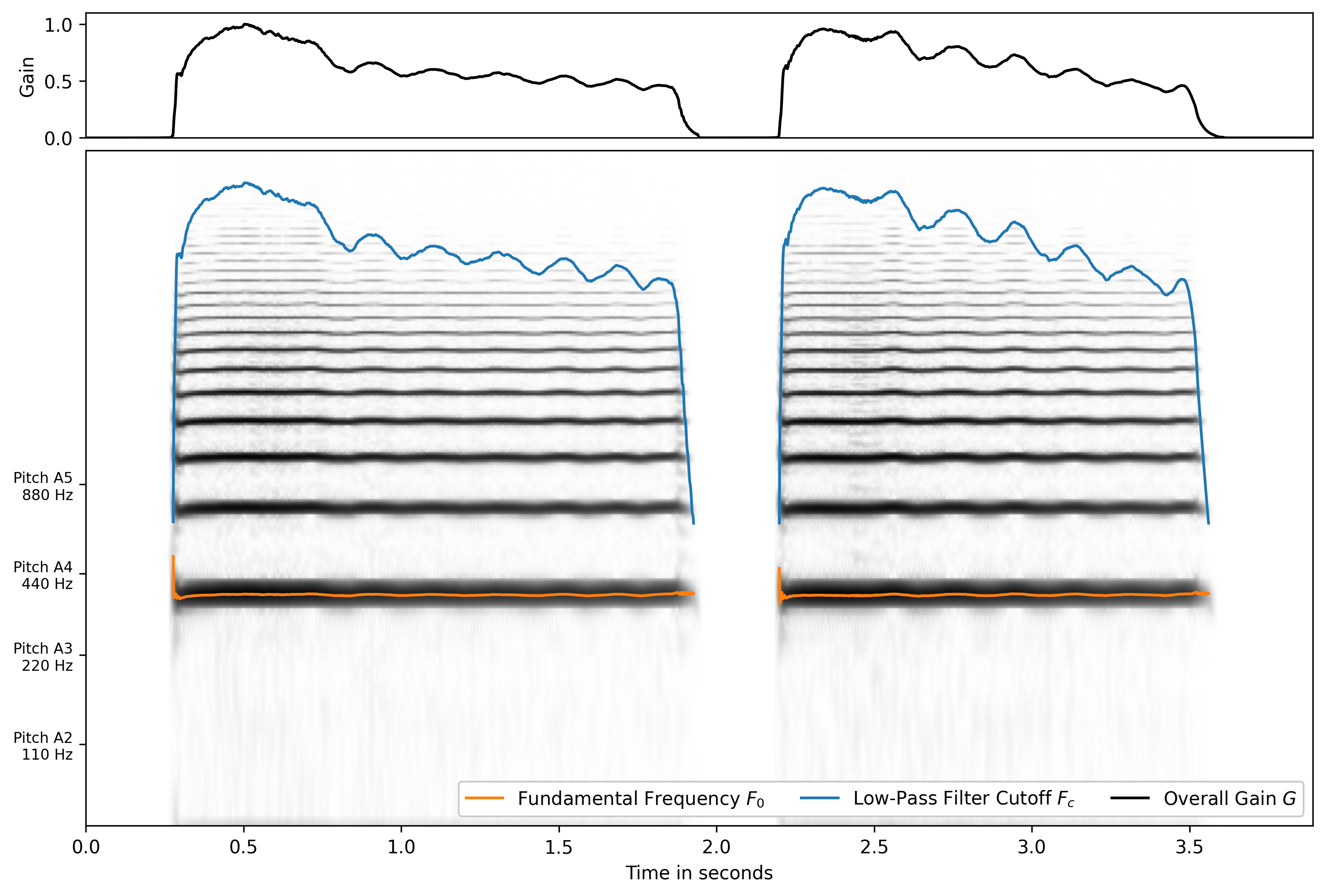
In this example, we focus on vibrato. The audio ist taken from the PHENICX Database and has been recorded in anechoic conditions.
Growl Listening Examples
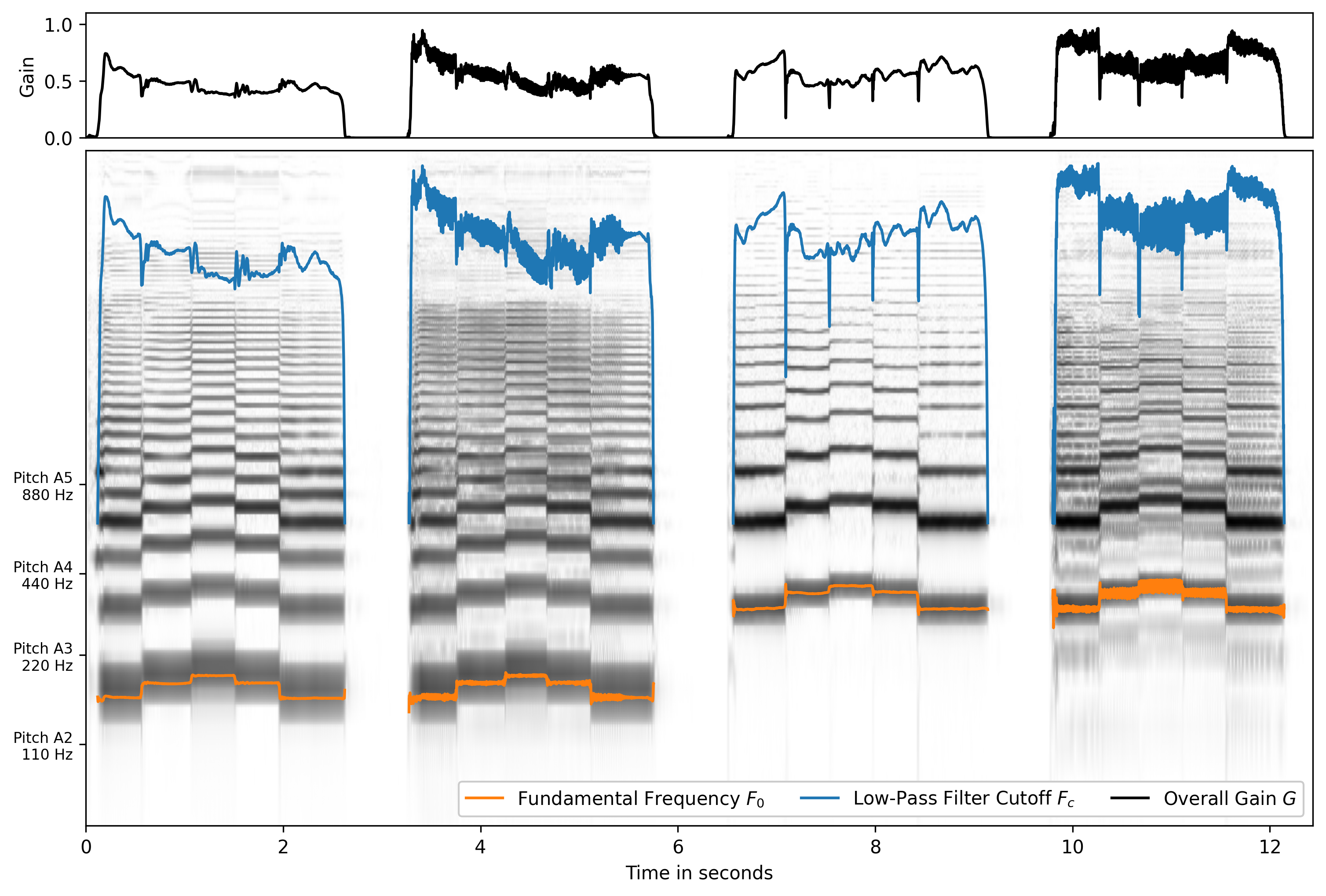
In this example, we focus on the growl playing technique. Sequences alternating between Legato and Legato with Growl
Convolution Reverb Listening Examples
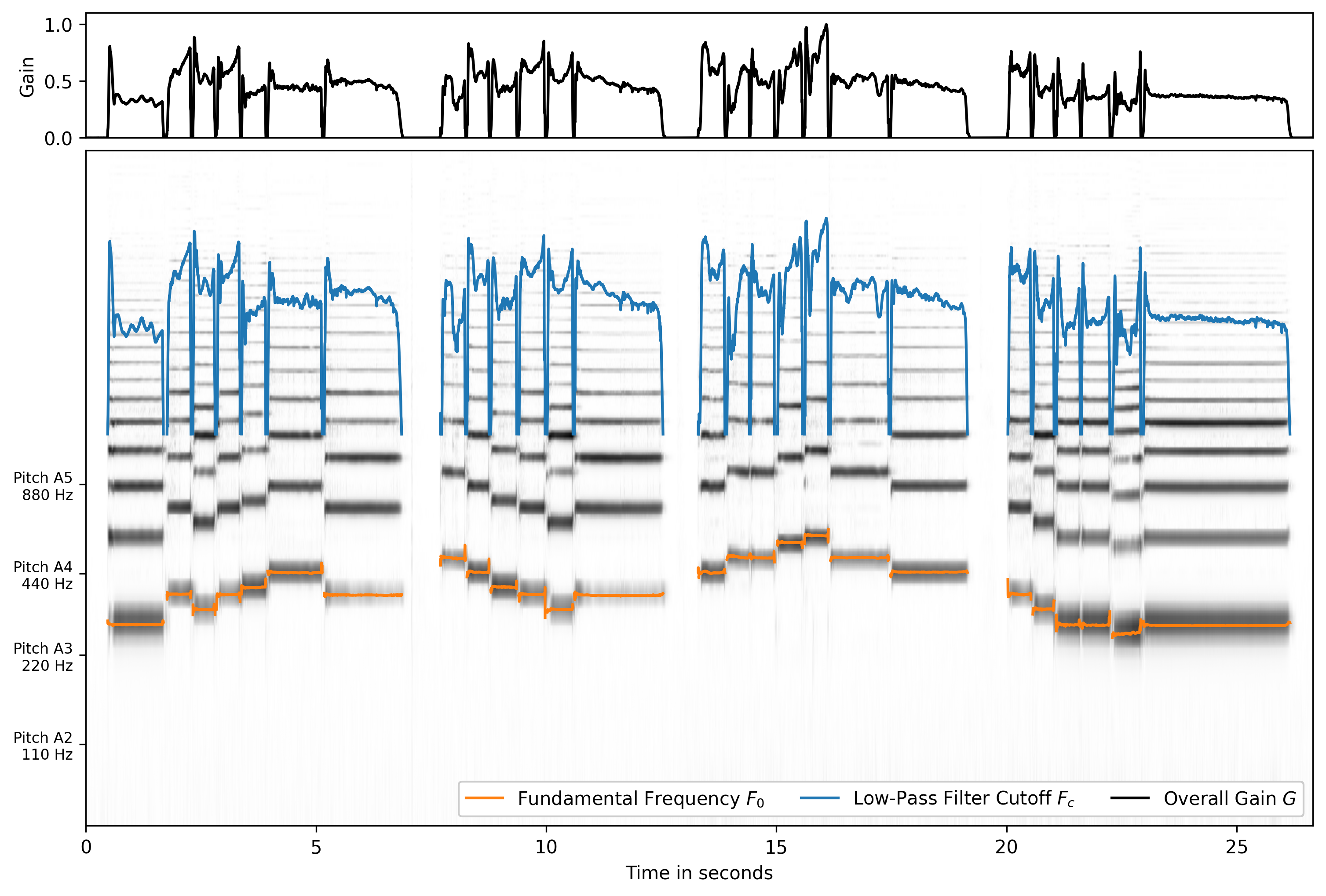
In this example, we use an oboe recording from the ChoraleBricks Dataset. The melody is the soprano part of the piece 'Christus, der ist mein Leben' (Vulpius). For resynthesis, an oboe pulsetable based on anechoic single note recordings in the MIS Database is used. In the last example, an estimate of the room impulse response is used as convolution reverb, the extraction of the room impulse response is described in [15].
But, can it Jazz?
In this example, we use a multitrack recording from the MedleyDB Dataset. It is an excerpt from the MusicDelta Modal Jazz, in which we synthesize both the saxophone and trumpet using the original micro-modulations and also add a second trumpet, by timbre transfer onto the saxophone control signal contours.
Other Resources
Already in the mid 1970s, electronic wind instruments such as the Martinetta and Variophon were using principles of pulse forming synthesis [2,11] to emulate tones of real acoustic wind instruments. Despite being implemented with analogue circuits, the sound comes relatively close to the actual instruments, thanks to micro-modulations captured with a wind controller.
Today, much more elaborate instrument models can be implemented in digital synthesizer software. The commercially available patches by Joel Blanco Berg achieve quite some realistic tones. Since their signal flow and modulation assignments can be inspected in PhasePlant, one can see that they use a refined implementation of wavetables plus time-variant filter, similar to the technique introduced by Horner and Beauchamp [7].
Acknowledgments

This work was funded by the Deutsche Forschungsgemeinschaft (DFG, German Research Foundation) under Grant No. 500643750 (MU 2686/15-1) and under Grant No. 555525568 (MU 2686/18-1). The International Audio Laboratories Erlangen are a joint institution of the Friedrich-Alexander-Universität Erlangen-Nürnberg (FAU) and Fraunhofer Institute for Integrated Circuits IIS.
References
- Frans Fransson
The source spectrum of double-reed wood-wind instruments
STL-QPSR, 7(4): 35–37, 1966.@article{Fransson66_SpectrumDoubleReeds_STL-QPSR, author = {Frans Fransson}, title = {The source spectrum of double-reed wood-wind instruments}, journal = {STL-QPSR}, volume = {7}, number = {4}, pages = {35--37}, year = {1966} } - Jobst P. Fricke
Formantbildende Impulsfolgen bei Blasinstrumenten
In Fortschritte der Akustik: Plenarvorträge und Kurzreferate der Tagung der Deutschen Arbeitsgemeinschaft für Akustik (DAGA), 1975.@inproceedings{Fricke75_Impulsfolgen_DAGA, author = {Jobst P. Fricke}, title = {Formantbildende Impulsfolgen bei Blasinstrumenten}, booktitle = {Fortschritte der Akustik: Plenarvorträge und Kurzreferate der Tagung der Deutschen Arbeitsgemeinschaft für Akustik ({DAGA})}, address = {Braunschweig, Germany}, year = {1975} } - Xavier Rodet
Time-Domain Formant-Wave-Function Synthesis
Computer Music Journal, 8(3): 9–14, 1984.@article{Rodet84_FormantWaveSynthesis_CMJ, author = {Xavier Rodet}, journal = {Computer Music Journal}, number = {3}, pages = {9--14}, publisher = {JSTOR}, title = {Time-Domain Formant-Wave-Function Synthesis}, volume = {8}, year = {1984} } - Ron W. Berry
Experiments in Computer Controlled Acoustic Modelling (A Step Backwards??)
In Proceedings of the International Computer Music Conference, (ICMC), 1988.@inproceedings{Berry88_AcousticModeling_ICMC, author = {Ron W. Berry}, title = {Experiments in Computer Controlled Acoustic Modelling {(A} Step Backwards??)}, booktitle = {Proceedings of the International Computer Music Conference, ({ICMC})}, address = {Cologne, Germany}, month = {September}, publisher = {Michigan Publishing}, year = {1988}, } - Douglas H. Keefe
Physical Modeling of Wind Instruments
Computer Music Journal, 16(4): 57–73, 1992.@article{Keefe92_PhysicalModeling_CMJ, author = {Douglas H. Keefe}, journal = {Computer Music Journal}, number = {4}, pages = {57--73}, publisher = {JSTOR}, title = {Physical Modeling of Wind Instruments}, volume = {16}, year = {1992} } - Julius O. Smith
Physical modeling using digital waveguides
Computer Music Journal, 16(4): 74–91, 1992.@article{Smith91_PhysicalModeling_CMJ, title={Physical modeling using digital waveguides}, author={Julius O. Smith}, journal={Computer Music Journal}, volume={16}, number={4}, pages={74--91}, year={1992}, publisher={JSTOR} } - Andrew Horner and James Beauchamp
Synthesis of trumpet tones using a wavetable and a dynamic filter
Journal of the Audio Engineering Society, 43(10): 799–812, 1995.@article{HornerB95_TrumpetSynthesis_JAES, title={Synthesis of trumpet tones using a wavetable and a dynamic filter}, author={Andrew Horner and James Beauchamp}, journal={Journal of the Audio Engineering Society}, volume={43}, number={10}, pages={799--812}, year={1995}, publisher={Audio Engineering Society} } - Istvan Derenyi and Roger B. Dannenberg
Synthesizing Trumpet Performances
In Proceedings of the International Computer Music Conference (ICMC), 1998.@inproceedings{DerenyiD98_TrumpetSynthesis_ICMC, author = {Istvan Derenyi and Roger B. Dannenberg}, title = {Synthesizing Trumpet Performances}, booktitle = {Proceedings of the International Computer Music Conference ({ICMC})}, address = {Ann Arbor, Michigan, USA}, month = {October}, publisher = {Michigan Publishing}, year = {1998}, } - Curtis Roads
Introduction to pulsar synthesis
The Journal of the Acoustical Society of America, 109(5 _Supplement): 2401–2401, 2001.@article{Roads01_PulsarSynthesis_JASA, title={Introduction to pulsar synthesis}, author={Curtis Roads}, journal={The Journal of the Acoustical Society of America}, volume={109}, number={5\_Supplement}, pages={2401--2401}, year={2001}, publisher={Acoustical Society of America} } - Wim D’haes and Xavier Rodet
A new estimation technique for determining the control parameters of a physical model of a trumpet
In Proceedings of the International Conference on Digital Audio Effects (DAFx), 2003.@inproceedings{DhaesR03_TrumpetPhysModControl_DAFx, title={A new estimation technique for determining the control parameters of a physical model of a trumpet}, author={Wim D’haes and Xavier Rodet}, booktitle={Proceedings of the International Conference on Digital Audio Effects {(DAFx)}}, address = {London, UK}, year={2003} } - Michael Oehler
Die digitale Impulsformung als Werkzeug für die Analyse und Synthese von Blasinstrumentenklängen
PhD Thesis, Hochschule für Musik und Theater Hannover, 2007.@phdthesis{Oehler08_ImpulseFormation_Dissertation, author = {Michael Oehler}, title = {Die digitale {I}mpulsformung als {W}erkzeug für die {A}nalyse und {S}ynthese von {B}lasinstrumentenkl\"{a}ngen}, school = {Hochschule f\"{u}r Musik und Theater Hannover}, year = {2007}, type = {Doctoral Dissertation}, } - Jesse H. Engel, Lamtharn (Hanoi) Hantrakul, Chenjie Gu, and Adam Roberts
DDSP: Differentiable Digital Signal Processing
In Proceedings of the International Conference on Learning Representations (ICLR), 2020.@inproceedings{EngelHGR20_DDSP_ICLR, title={{DDSP}: Differentiable Digital Signal Processing}, author={Jesse H. Engel and Lamtharn (Hanoi) Hantrakul and Chenjie Gu and Adam Roberts}, booktitle={Proceedings of the International Conference on Learning Representations ({ICLR})}, year={2020}, } - Murray Campbell, Joël Gilbert, and Arnold Myers
The science of brass instruments
Springer, 2021.@book{CampbellGM21_ScienceBrassInstr_book, title={The science of brass instruments}, author={Murray Campbell and Jo{\"e}l Gilbert and Arnold Myers}, volume={436}, year={2021}, publisher={Springer} } - Stefan Balke, Axel Berndt, and Meinard Müller
ChoraleBricks: A Modular Multitrack Dataset for Wind Music Research
Transaction of the International Society for Music Information Retrieval (TISMIR), 8(1): 39–54, 2025. PDF Details Demo DOI@article{BalkeBM25_ChoraleBricks_TISMIR, author = {Stefan Balke and Axel Berndt and Meinard M{\"u}ller}, title = {{ChoraleBricks}: {A} Modular Multitrack Dataset for Wind Music Research}, journal = {Transaction of the International Society for Music Information Retrieval ({TISMIR})}, volume = {8}, number = {1}, pages = {39--54}, year = {2025}, doi = {10.5334/tismir.252}, url-pdf = {https://transactions.ismir.net/articles/10.5334/tismir.252/2025_BalkeBM_ChoraleBricks_TISMIR_ePrint.pdf}, url-demo = {https://www.audiolabs-erlangen.de/resources/MIR/2025-ChoraleBricks}, url-details={https://transactions.ismir.net/articles/10.5334/tismir.252} } - Simon Schwär, Christian Dittmar, Stefan Balke, and Meinard Müller
Differentiable Pulsetable Synthesis for Wind Instrument Modeling
In Proceedings of the IEEE International Conference on Acoustics, Speech, and Signal Processing (ICASSP): 14792–14796, 2026. PDF Details@inproceedings{SchwaerDBM26_DiffPulse_ICASSP, author = {Simon Schw{\"a}r and Christian Dittmar and Stefan Balke and Meinard M{\"u}ller}, title = {Differentiable Pulsetable Synthesis for Wind Instrument Modeling}, booktitle = {Proceedings of the {IEEE} International Conference on Acoustics, Speech, and Signal Processing ({ICASSP})}, year = {2026}, pages = {14792--14796}, address = {Barcelona, Spain}, url-details = {https://audiolabs-erlangen.de/resources/MIR/2026-ICASSP-DiffPulse}, url-pdf = {https://ieeexplore.ieee.org/document/11462505}, }