


dPLP: A Differentiable Version of Predominant Local Pulse Estimation
This is the accompanying website for the following paper:
- Ching-Yu Chiu, Sebastian Strahl, and Meinard Müller
dPLP: A Differentiable Version of Predominant Local Pulse Estimation
In Proceedings of the International Society for Music Information Retrieval Conference (ISMIR), 2025. Details@inproceedings{ChiuSM25_dPLP_ISMIR, author = {Ching-Yu Chiu and Sebastian Strahl and Meinard M{\"u}ller}, title = {{dPLP}: {A} Differentiable Version of Predominant Local Pulse Estimation}, booktitle = {Proceedings of the International Society for Music Information Retrieval Conference ({ISMIR})}, address = {Daejeon, Korea}, year = {2025}, url-details = {https://www.audiolabs-erlangen.de/resources/MIR/2025_ChiuSM_dPLP_ISMIR} }
Abstract
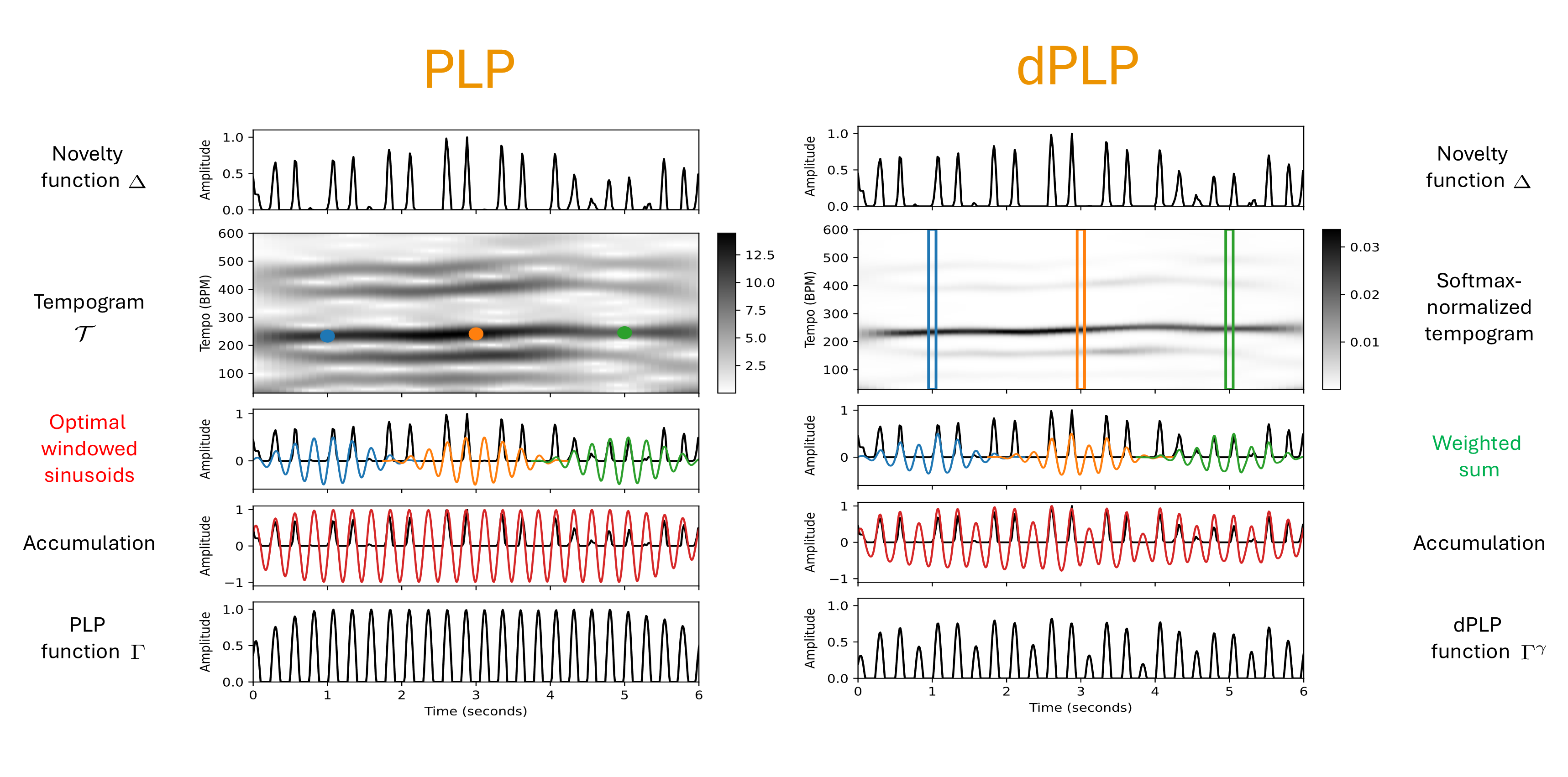
Predominant Local Pulse (PLP) estimation is a key technique in rhythmic analysis of music recordings, designed to identify the most salient pulse in an audio signal while adapting to local tempo variations. Unlike global tempo estimation, which assumes a fixed tempo, PLP dynamically adjusts to changes in tempo and rhythm, making it particularly effective as a post-processing strategy to enhance the locally periodic structure of a given input novelty or activity function. Traditional PLP estimation relies on a max operation to select the most prominent periodicity, limiting its use in differentiable learning frameworks. In this paper, we introduce dPLP, a differentiable version of PLP estimation that replaces the max operation when selecting a locally optimal periodicity kernel with a softmax-based weighting scheme. This modification ensures good gradient flow, allowing PLP to be seamlessly integrated into deep learning pipelines as an intermediate layer or as part of the loss function. We provide technical insights into its differentiable formulation and present experiments comparing it to the original non-differentiable PLP approach. Additionally, case studies in beat tracking highlight the advantages of dPLP in improving periodicity-aware representations within neural network architectures.
PLP vs. dPLP
Acknowledgements
This work was funded by the Deutsche Forschungsgemeinschaft (DFG, German Research Foundation) under Grant No. 500643750 (MU 2686/15-1). The authors are with the International Audio Laboratories Erlangen, a joint institution of the Friedrich-Alexander-Universität Erlangen-Nürnberg (FAU) and Fraunhofer Institute for Integrated Circuits IIS.
References
- Peter Grosche and Meinard Müller
Extracting Predominant Local Pulse Information from Music Recordings
IEEE Transactions on Audio, Speech, and Language Processing, 19(6), 2011.@article{GroscheM11_PLP_TASLP, author = {Peter Grosche and Meinard M{\"u}ller}, journal = {IEEE Transactions on Audio, Speech, and Language Processing}, title = {Extracting Predominant Local Pulse Information from Music Recordings}, number = {6}, publisher = {IEEE}, volume = {19}, year = {2011}, URL = {http://dx.doi.org/10.1109/TASL.2010.2096216}, } - Meinard Müller and Ching-Yu Chiu
A Basic Tutorial on Novelty and Activation Functions for Music Signal Processing
Transaction of the International Society for Music Information Retrieval (TISMIR), 7(1): 179–194, 2024. PDF Demo DOI@article{MuellerC24_TutorialNovelty_TISMIR, author = {Meinard M{\"u}ller and Ching-Yu Chiu}, title = {A Basic Tutorial on Novelty and Activation Functions for Music Signal Processing}, journal = {Transaction of the International Society for Music Information Retrieval ({TISMIR})}, volume = {7}, number = {1}, pages = {179--194}, year = {2024}, doi = {10.5334/tismir.202}, url-pdf = {https://audiolabs-erlangen.de/content/05_fau/professor/00_mueller/03_publications/2024_Mueller_TutorialNovelty_TISMIR_ePrint.pdf}, url-demo = {https://github.com/groupmm/edu_novfct} }